Ever had a strategy 'rolled out' to you?
How did it go?
Most organisations have a strategy document. It usually runs to somewhere between 20 and 60 slides, covers five or six pillars, and ends with a roadmap. It's been through three rounds of leadership review, and everyone broadly agrees with it.
Then someone asks a team member to explain the strategy in their own words, and you get a different answer every time. Or worse - you get a pause, followed by something that sounds like someone trying to remember a list.
That's the tell. If your strategy sounds like a list when people try to repeat it, it's probably because it is one. And the things about lists is that nobody remembers them and nobody retells them which means they're unlikely to be motivated by them to make better decisions.
You can't tell a story about a list.
A strategy is not a plan
Some people use the words "strategy" and "plan" interchangeably, and they're not the same thing. A plan is a set of actions. A strategy is the logic that explains why you chose those actions over all the other actions you could have taken.
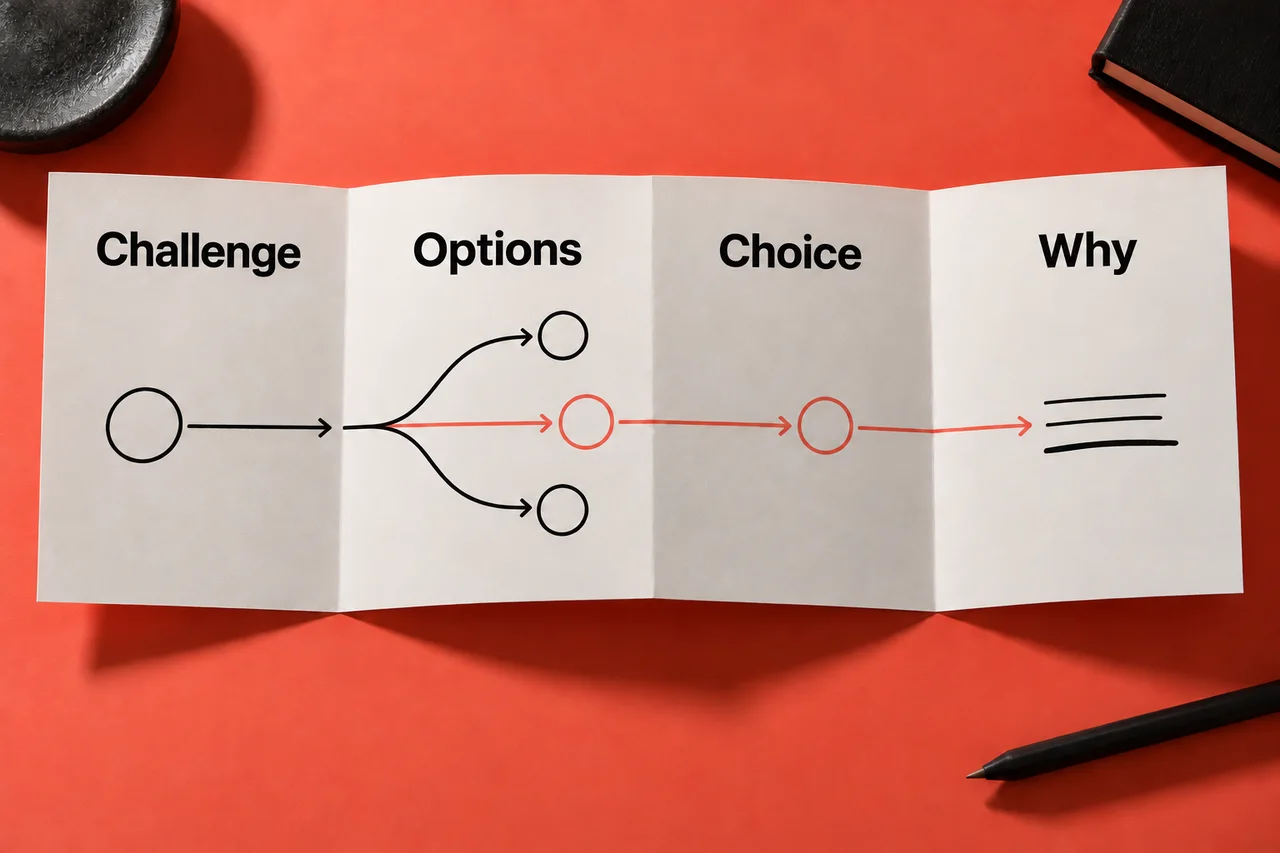
A plan says "we will do X, Y, and Z." A strategy says "we're facing this tension, we had these options, and we chose this path because of this reasoning - which means we're deliberately not doing those other things."
One is a to-do list. The other is a narrative. And that difference has huge implications for whether anyone in your organisation actually understands the direction you've set.
Strategy already has a plot
Think about what makes a story work. You need a tension - something unresolved. You need a choice - someone deciding what to do about it. You need motivation - why this path and not another. And you need stakes - what changes as a result.
A real strategy contains all of those things naturally. The tension is the market challenge or competitive reality you're responding to. The choice is the strategic direction. The reasoning is why this path beats the alternatives. The stakes are what you gain and what you trade away.
You don't need to "add storytelling" to your strategy. A strategy that's actually a strategy already is a story. The problem is that somewhere between the first draft and the final deck, most organisations sand off exactly the elements that make it one.
The choices get softened into vague language so nobody feels excluded. The trade-offs disappear because they make people uncomfortable. The tension gets buried under 15 slides of market analysis. What you're left with is a list of initiatives and a roadmap. A plan, dressed in strategy's clothes.
A list doesn't scale
When you cascade a plan through an organisation, you're asking people to memorise a list. Some will. Most won't. And the ones who do will still struggle to make judgment calls when the situation doesn't match a line item - because a list doesn't give you decision-making logic. It gives you instructions.
A strategy told as a story works differently. When people understand the tension you're responding to, the choice you made, and the reasoning behind it, they can make decisions even in situations the plan didn't anticipate. They have the "why" - and the "why" scales in a way that a checklist never will.
This is where strategic clarity becomes a genuine competitive advantage. An organisation where a thousand people can explain the strategy in their own words - and use it to make better decisions without being told what to do - will always outperform one where the strategy lives in a document nobody can remember. That kind of clarity only happens when the strategy is simple enough to remember and compelling enough to retell. When it works as a story.
A simple test
Take your current strategy document and try to answer three questions from it:
- What is the core tension or challenge we're responding to?
- What did we choose to do - and what did we explicitly choose not to do?
- Why this path and not the alternatives?
If your document answers all three clearly, you probably have a strategy. If it mostly answers "what are we going to do" without addressing the choices and trade-offs behind those actions, you have a plan. Plans are useful - you need them. But they sit downstream of strategy. The problems start when the plan is the only document that exists, and people mistake it for the strategy itself.
Where the story keeps getting lost
It's worth noting that this isn't usually a thinking problem. Most leadership teams have genuinely wrestled with hard choices. The tension was real, the debates happened and the trade-offs were felt.
So the reasoning exists - it just never made it into the document.
What made it into the document was the outcome of those debates - the resulting priorities and initiatives - stripped of all the context that made them meaningful. The strategy got reduced to its conclusions, and conclusions without context are just a list of assertions.
Try telling a story where you only share the ending.
The discipline of strategic storytelling isn't about making your strategy prettier or more persuasive. It's about refusing to let the story elements get removed in the first place. Keep the tension visible. Name the choices that were on the table. Be explicit about why you chose one path over another. Show what you're trading away.
Don't trip at the last hurdle - the best strategy is useless if no one gets it.