I spend a surprising amount of time at work helping people tell stories.
Not stories in the traditional sense, but strategic stories: the kind designed to help a leadership team understand a problem, see something differently, make a decision or commit to a new direction.
And I think we often make strategic storytelling much more complicated than it needs to be.
There are endless frameworks for structuring presentations, building narratives and communicating strategy, but the pattern I keep coming back to is actually quite simple:
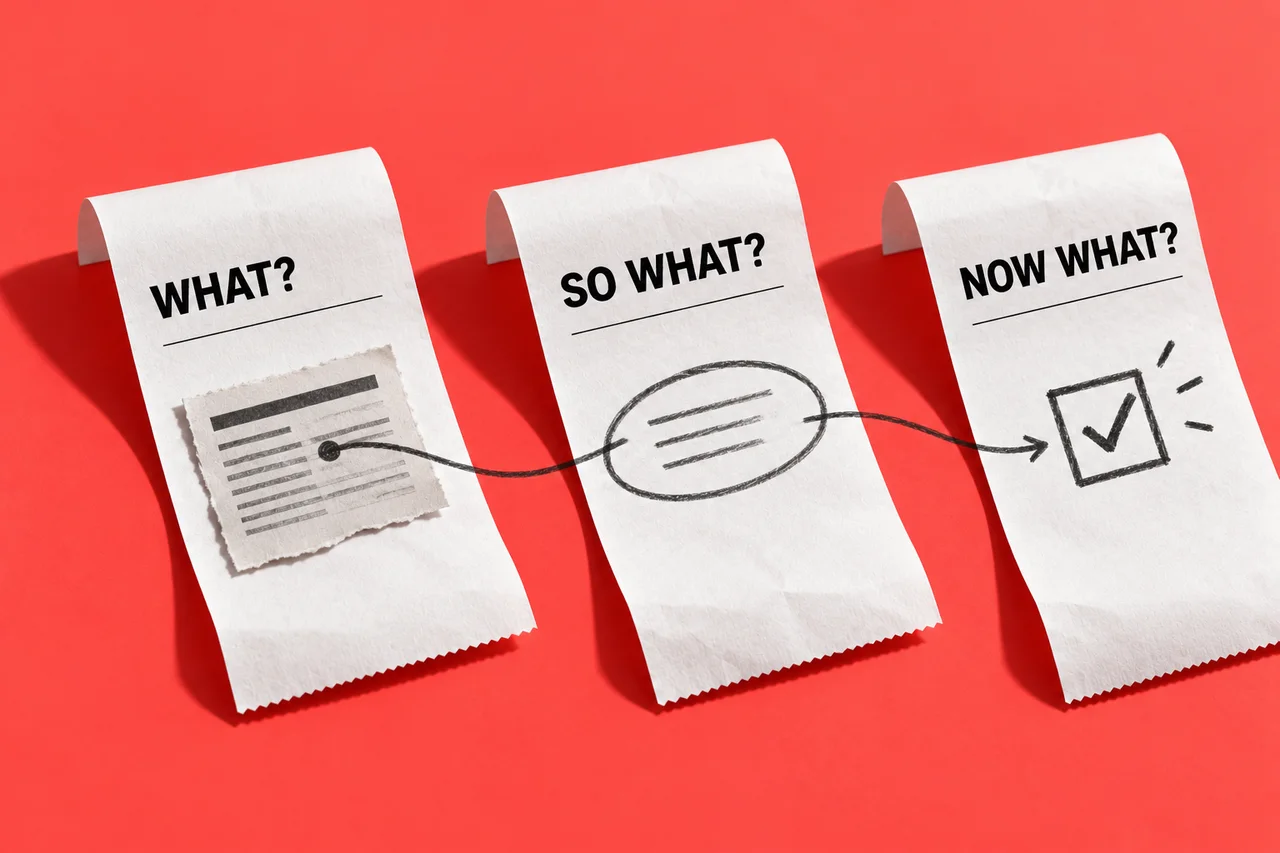
What? So what? Now what?
Most communication starts with the what.
Here is what is happening. Here is what the data tells us. Here is what customers are doing. Here is what competitors are doing. Here is what we learned from the research.
This part matters, of course. You need the evidence. You need to understand the situation properly. But organisations are often so good at the “what” that they accidentally mistake it for the story itself.
It isn’t.
You can spend 20 slides explaining what is happening and still leave everyone in the room wondering what any of it actually means.
That's where the so what becomes important.
If this is true, what does it change? Which assumptions no longer hold? What becomes more important, and what becomes less important? Where does this create an opportunity, a risk or a choice that we were not previously seeing clearly?
This is usually where the real strategic thinking happens, because you're moving beyond information and into interpretation. You're no longer simply presenting the facts; you're making a judgment about what those facts mean.
And that's harder and riskier but it's usually what we're paid for.
A useful test is to imagine someone listening to your entire presentation and then asking: Okay, so what?
If the answer is not immediately clear, you're not there yet.
I've seen teams spend weeks producing excellent analysis and then dedicate a single slide at the end to the implications. In many cases, the balance should be almost the reverse. The analysis is important because it earns you the right to say something meaningful about what it means.
That interpretation is usually the most valuable part of the work.
But even a strong “so what” is not quite enough, because strategic storytelling should ultimately create some form of movement.
That's the now what.
If we believe this implication, what should happen because of it?
Sometimes that means making a decision. Sometimes it means changing a priority, making an investment, building a capability, stopping something, testing an idea or simply resolving a question that has suddenly become much more important.
The “now what” does not always need to be a detailed action plan, but there should be a consequence. Something should change as a result of understanding the story.
Otherwise you have communicated something interesting rather than something strategic.
What I like about what → so what → now what is that it works at almost any scale. You can use it to structure an entire strategy, a presentation, a single slide, an email or even a five-minute conversation.
You can also use it to pressure-test your own thinking.
What do I believe is happening? So what does that mean? Now what should we do about it?
And there is one final thing that makes the framework particularly useful: you can keep asking the questions.
Your first “so what” often becomes the next “what”.
A competitor changes its model.
So what?
Customer expectations start to change.
So what?
Our current experience becomes less competitive.
So what?
We need to radically rethink where we're investing and which capabilities we're building.
You keep going until you reach something that is important enough to change a choice.
That, to me, is the heart of strategic storytelling. It's not about making the presentation more dramatic or forcing everything into a clever narrative arc.
It's about taking the thinking far enough that people can clearly understand what is happening, why it matters, and what we should do next.