
If your company is like mine, you’ve probably heard marketers throw around the term “omnichannel" a lot. Frustratingly, it’s often used interchangeably with customer experience (CX) and everyone struggles to explain what it means and how it drives business outcomes.
Attend any conference, and you’ll see omnichannel success stories from other industries. But in Pharma? Virtually no strong examples. So, what’s going on?
Here are some myths I often find myself dismantling in my conversations at work.
Myth 1: Omnichannel is complicated
Let’s clear this up. You’ve probably seen omnichannel explained like this:
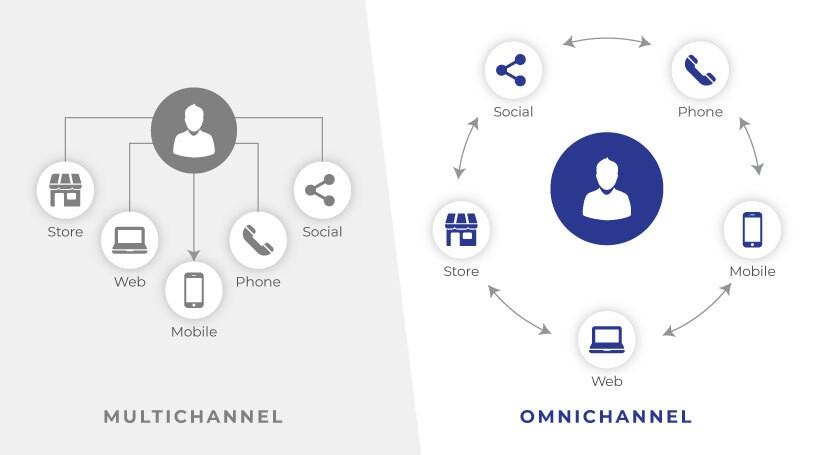
Wow! The customer was at the top and now they're at the center! See? We placed them in the middle of the picture to show how much we care!
Or perhaps you’ve seen something like this?
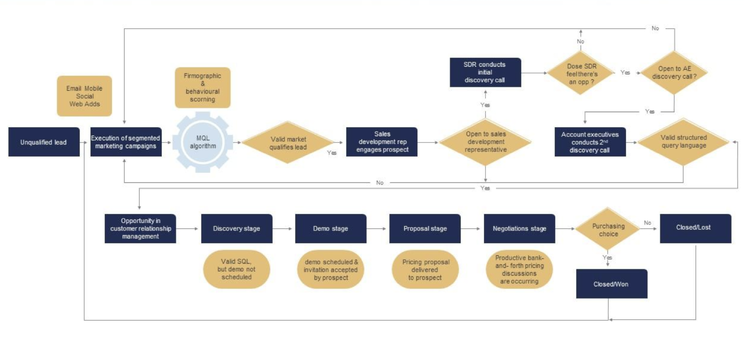
Omnichannel = squiggly lines & arrows.
I find this hard to work with.
Here’s what omnichannel really is:
Omnichannel simply means interacting through more than one channel in a coordinated way.
If we’re uncoordinated, it’s multichannel.
If we’re coordinated, it’s omnichannel.
That’s it.
Yet, when introduced to Pharma leaders, we often hear:
"This is going to be hard," or
"It’s a journey—don’t expect results soon," or
"Just focus on getting people to use the CRM; we can’t do anything without more data."
Sure, there are levels of sophistication (for some people, Omnichannel means complex marketing automation), but good luck jumping in a Formula One car when you're still learning to drive.
Grounding ourselves in basic principles is key: How might we start to coordinate our efforts across different channels more effectively?
Any team can have this conversation today.
Myth 2: Omnichannel is Something you Deliver
I often hear Pharma leaders asking:
"How are we going to deliver Omnichannel?" or
"When are we delivering Omnichannel?"
Here’s the thing:
Omnichannel isn’t something you deliver; it’s something you deliver through.
The real question we need to be asking is, what are we trying to deliver through omnichannel and why?
I’ve heard a mix of answers, ranging from very operational things like:
"we’re delivering personalised content!" (after all content is King, right??)
to vague statements like:
"we’re delivering business results!"
The inconsistency is scary: we must be clear on what we’re trying to achieve before crafting plans to achieve it.
Before we jump in the race car, don't we want to make sure we're pointing the right way down the track?
Here’s my take:
- To have any chance of driving business impact, whilst remaining customer centric: we have to focus much more on delivering customer experiences (through omnichannel).
This lens drives coordination - the connectedness of omnichannel is not connectedness for the sake it of it, it's connectedness for the sake of delivering a cohesive customer experience. So we'd better be clear on what we want that experience to look and feel like or else, how will we know how to connect it up?
- The purpose of these experiences is to drive our strategic business outcomes
Often I see 'Omnichannel Strategies' or CX efforts running parallel to commercialisation strategy (sometimes distracting teams from the commercialisation strategy!). This is wrong.
Becoming more intentional about driving business outcomes through customer experiences sits at the core of Outcomes-Driven Customer Experience (click here for my previous post introducing Outcomes-Driven CX).
Strategy
Do the ‘right thing’
How do we ensure that we’re focused on the right strategic opportunities and the interventions most likely to drive the change we seek?
Omnichannel
Do the ‘thing right’
How do we increase the likelihood that those interventions will be successful by delivering them as one cohesive experience down channels that make sense?
Customer Experience
Outcomes-Driven CX involves doing the 'right thing' AND doing the 'thing right', Jed Casey (2024)
The focus is not ‘omnichannel’, omnichannel is simply an enabler once we’re clear on the Outcomes we want to achieve, and the experiences required to drive them.
The stakes for patients, healthcare ecosystems and Pharma businesses are too high for needless noise with little impact.
Time to step beyond the buzzwords and build experiences that enable meaningful change.
This is part 2 in series on Outcomes-Driven CX, where I'll be breaking down an approach to more intentionally crafting customer experiences that drive business outcomes in Pharma.